
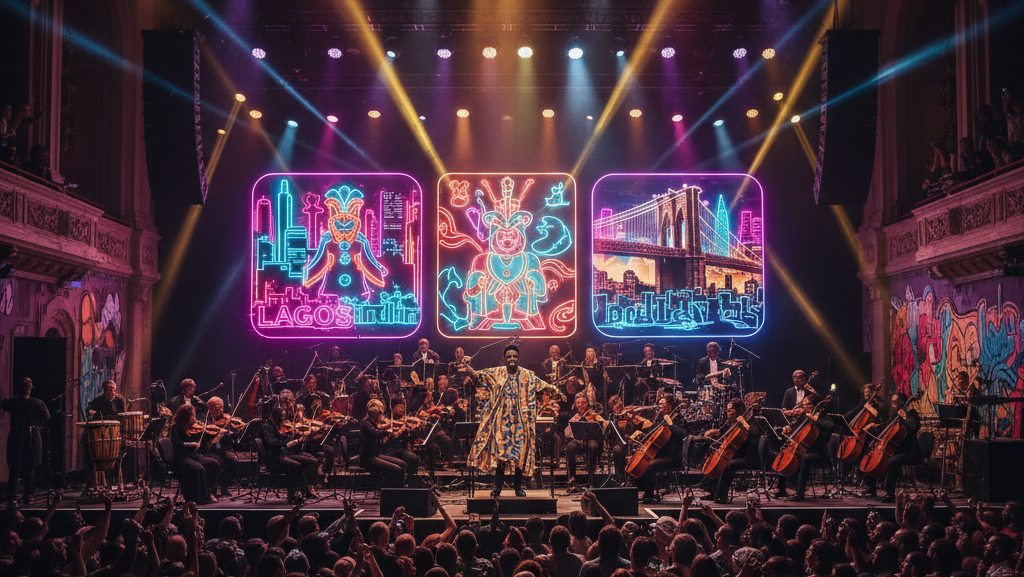
On November 8, 2024, Brooklyn’s historic Kings Theatre became hallowed ground. Grammy-nominated Afrobeats sensation Asake didn’t just perform—he made history as the first African artist to headline Red Bull Symphonic in the United States, bringing the vibrant heartbeat of Lagos to New York City in a groundbreaking fusion of Afrobeats and classical orchestration.
A Night of Cultural Collision
At 8:33 p.m., the red curtains opened to reveal a 33-piece orchestra, with LED screens simultaneously displaying the hustle of New York and Lagos—a poetic representation of two cities united by grit, determination, and culture. Dressed in a sharp gray three-piece suit by Nigerian designer VICNATE, Asake emerged to perform over 20 selections from his acclaimed albums, including Mr. Money With the Vibe, Work of Art, Lungu Boy, and his forthcoming MONEY.
Under the masterful direction of conductor Glenn Alexander II, with arrangements by Anthony Parnther, the evening transformed Asake’s signature sound—a blend of Yoruba storytelling, fújì, Afrobeats, and amapiano—into an orchestral experience that honored tradition while pushing boundaries. The stage itself told a story: his band at the top, the orchestra and conductor in the middle, an eight-piece choir and dancers at the lower level, with Asake moving fluidly between them all.
The setlist was a journey through emotion and energy. From the violin-led opening of “Dull” to uptempo bangers like “Sunmomi,” “Organize,” and “Joha” (complete with explosive drum breaks and Nigerian street dance), to soulful moments like “Nzaza” mashed with 2Pac’s “Do for Love,” the night showcased Asake’s versatility. Surprise appearances from Wizkid, Gunna, Central Cee, Tiakola, and Fridayy elevated the event into a global celebration of Black music.
Understanding Red Bull Symphonic
Red Bull Symphonic is where worlds collide. This innovative global concert series pairs contemporary artists with full-scale classical orchestras to reimagine modern hits through symphonic arrangements. From Egyptian trap star Marwan Pablo to hip-hop legends Rick Ross and Metro Boomin, the series has taken audiences on unforgettable musical journeys across the globe—from Vienna to Jordan to Los Angeles. Asake’s Brooklyn performance marked the series’ first-ever New York City debut.
The magic happens when music arrangers from the classical world reimagine an artist’s entire catalog, adapting instruments, rhythms, and tempo to create something entirely new. It’s not just about the wow factor—it’s about bringing people together from different musical backgrounds to experience the power of live music in a fresh, unexpected way.
A Quick Lesson: Orchestra vs. Symphony Orchestra
Let’s talk terminology. An orchestra is a large musical ensemble featuring strings, woodwinds, brass, and percussion instruments. But not all orchestras are created equal. A chamber orchestra is smaller—around 50 musicians or fewer—perfect for intimate chamber music written for private halls and palace rooms.
A symphony orchestra is the largest type, boasting 80 to 100+ musicians organized into four distinct sections: strings, woodwinds, brass, and percussion. It has both the number of players and variety of instruments needed to perform symphonies—those elaborate, multi-movement compositions by masters like Beethoven, Brahms, and Mozart.
Here’s the fun part: philharmonic orchestras are actually the same as symphony orchestras. The difference is purely semantic. “Symphony” comes from Greek meaning “agreement of sound,” while “philharmonic” means “love of harmony.” Cities often use both terms to distinguish between multiple ensembles—like the London Symphony Orchestra and London Philharmonic Orchestra—but musically, they’re identical.
For Asake’s Red Bull Symphonic, the 33-piece orchestra brought the full symphonic treatment to Afrobeats, proving that classical instrumentation can breathe new life into contemporary African music without stripping away its raw, street-born identity.
Why This Matters for the Culture
Asake’s performance wasn’t just a concert—it was a cultural statement. At a time when Afrobeats dominates global charts and clubs from Lagos to London to New York, seeing it elevated in a symphonic setting pushes the genre into the realm of high art. It proves what we’ve always known: African music isn’t confined by genre, space, or expectation. It belongs everywhere.
This historic night demonstrated Afrobeats’ evolution and versatility on the global stage, with strings, brass, and percussion intertwining with Yoruba rhythms to create something both familiar and strikingly new. For the diaspora watching Asake command that stage—moving from his band to the orchestra to the choir, closing with “Peace Be Unto You” accompanied by drummers in full force—it was proof that our music, our stories, and our culture deserve every stage, every spotlight, every standing ovation.
As social media erupted with clips of the performance, one sentiment echoed through the responses: “We’re witnessing greatness.” And we were.