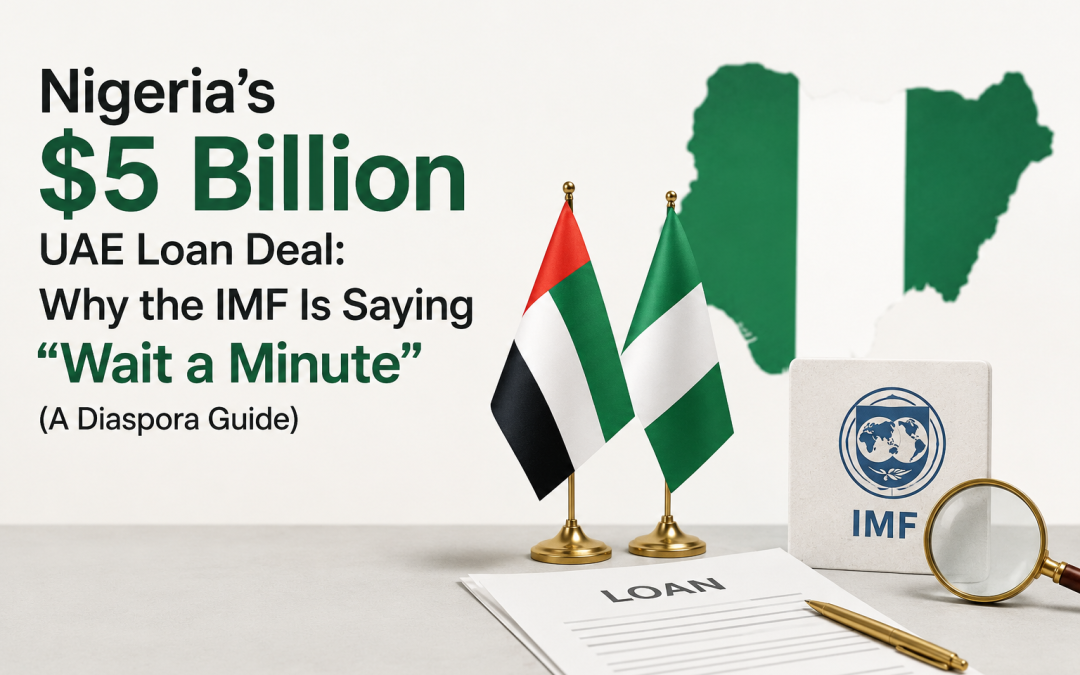
If you’ve been half-following Nigerian financial news from Houston, London, Toronto, or Johannesburg, you’ve probably seen headlines about a fresh $5 billion borrowing plan and the IMF pumping the brakes on it. Let’s break down what’s actually going on — no jargon, no wahala.
## What Happened, in Plain English
The National Assembly approved President Tinubu’s request to borrow $6 billion externally to help fund the 2026 budget, infrastructure, and refinance existing debt. Tucked inside that package is a $5 billion deal with **First Abu Dhabi Bank** (UAE), structured as a **total return swap (TRS)** — a type of derivative-based financing.
The IMF’s man in Abuja, Christian Ebeke, publicly discouraged Nigeria from going through with it, warning the arrangement “belongs to a category of deals that are often complex and opaque,” and that similar structures elsewhere have carried real transparency and financial risk. His advice: stick to Eurobonds and concessional loans instead — the more boring, tested paths.
## The Simplest Explanation Possible
Think of a normal loan like borrowing money from your uncle: you get cash, you pay it back with interest, everyone knows the terms. Straightforward.
A total return swap is more like betting on a stock’s performance without ever owning the stock. In Nigeria’s case, the government (or an asset it controls) would effectively swap the “returns” or risk on something — often government bonds or similar assets — with the bank, in exchange for upfront cash now. It’s less “loan,” more “financial contract dressed up as a loan.”
This is the same family of financing NNPC has used repeatedly with oil — Project Gazelle, Project Eagle, the Afreximbank crude-for-cash deals — where the country pledges future oil barrels for cash today.
## The Benefits (Why Nigeria Wants This)
- **Fast cash, no immediate spending cuts.** Governments under fiscal pressure like quick liquidity without the political pain of raising taxes or cutting subsidies.
- **Avoids market scrutiny of a traditional Eurobond**, which requires public pricing, rating agency reviews, and investor roadshows.
- **Flexible structuring** — derivative deals can sometimes be tailored around specific assets or timing needs that plain bonds can’t match.
## The Risks (Why the IMF Is Uneasy)
- **You can’t properly price what you can’t see.** Derivative-based deals are typically privately negotiated, so the public — and sometimes even regulators — don’t know the real cost, collateral, or trigger conditions.
- **Hidden debt.** These structures don’t always show up cleanly on the books as “debt,” which can understate how much Nigeria truly owes.
- **Collateral exposure.** If the deal is backed by assets (oil, reserves, bonds), a downturn could force Nigeria to hand over more value than the cash it received — this is exactly what happened to other African nations with resource-backed loans.
- **Loss of future flexibility.** Just like the oil-for-cash deals lock in barrels years ahead, a swap can lock in financial exposure that limits Nigeria’s room to maneuver if oil prices or interest rates move against it.
## Why “Opaque” Is the Word Everyone Keeps Using
“Opaque” simply means: **you can’t see through it.** With a normal government bond, the interest rate, maturity date, and repayment schedule are published and known to everyone — investors, citizens, the National Assembly. With a derivative-based swap like this, the actual terms — the reference asset, the trigger events, what happens if things go wrong — are usually contained in private contracts. Nigerians (and lenders, and rating agencies) can’t independently verify what the country is truly on the hook for. That opacity is precisely what worries the IMF: not necessarily that the deal is corrupt, but that its true risk is very hard to assess from the outside.
## Why This Matters to You in the Diaspora
Every dollar of “hidden” or hard-to-value debt affects the naira’s stability, Nigeria’s credit rating, and ultimately the cost of sending money home, investing in Nigerian assets, or planning a return. Debt transparency isn’t an abstract policy debate — it’s the difference between a currency you can plan around and one that keeps surprising you.
## Bottom Line
Nigeria needs money — that part isn’t controversial. The real question is whether it borrows in ways the public can scrutinize, or in ways that quietly build up risk behind closed doors. The IMF is betting on boring and transparent. Abuja, so far, seems tempted by fast and flexible. Watch this space.