
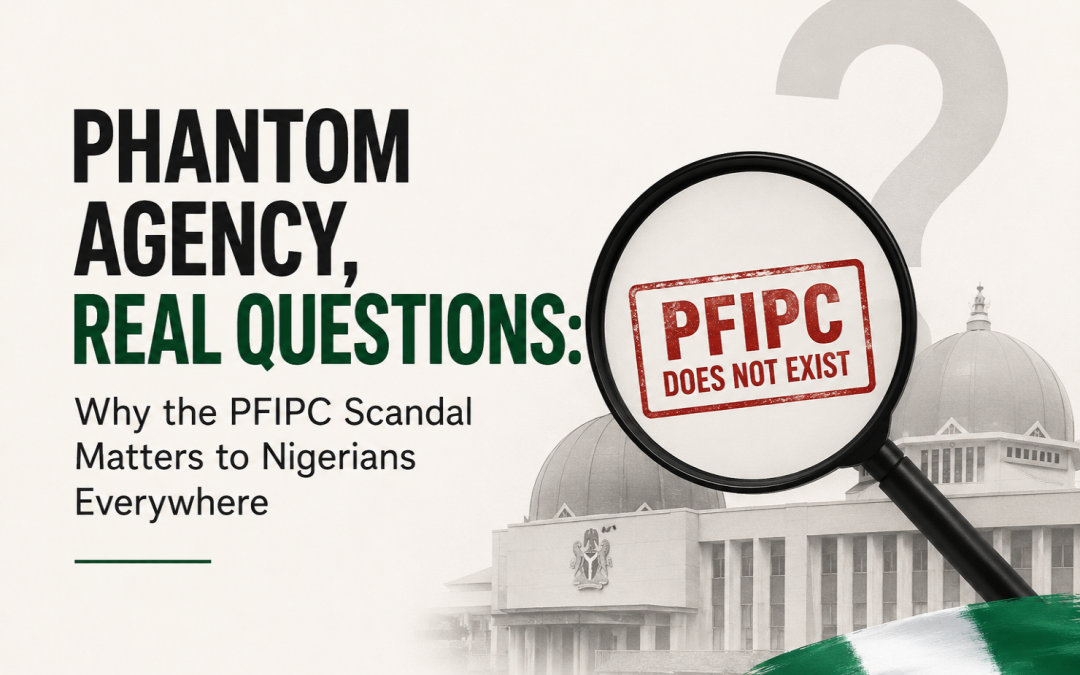
A political controversy unfolding in Abuja has become one of Nigeria’s most troubling governance stories of 2026. At the center is a mysterious organization called the Presidential Foreign Intervention Promotion Council (PFIPC)—an agency the Presidency insists never legally existed, yet one that reportedly operated from the Federal Secretariat, maintained accounts with the Central Bank of Nigeria, and appeared in the 2026 federal budget.
For Nigerians at home and abroad, the scandal raises uncomfortable questions about transparency, accountability, and the integrity of public institutions.
According to court filings, media investigations, and statements from the Presidency, Prince Adeniyi Adeyemi presented himself as the Director-General of the PFIPC. Authorities allege that he forged presidential appointment documents, official State House letterheads, and other government records to create the appearance of legitimacy. Police have charged him with conspiracy, forgery, impersonation, and obtaining by false pretence. Investigators also claim he opened dozens of bank accounts linked to fictitious government entities, including one with the Central Bank of Nigeria. The Presidency maintains that no public funds were transferred into those accounts, although investigators argue the accounts represented a serious attempt to penetrate Nigeria’s financial system. (Punch Newspapers)
But the story became far more explosive after Adeyemi fought back.
He has publicly accused President Bola Tinubu’s Chief of Staff, Femi Gbajabiamila, of demanding ₦600 million to secure his appointment, claiming that ₦400 million had already been paid through an intermediary. He further alleged that disagreements arose after he refused to surrender nearly half of what he described as a proposed ₦27.4 billion take-off allocation for the council. The Presidency has categorically denied every allegation, describing Adeyemi as a long-time fraudster attempting to blackmail senior government officials after his arrest. (Punch Newspapers)
Perhaps the most difficult question facing the government has nothing to do with Adeyemi’s allegations.
If the PFIPC never legally existed, how did references to the agency reportedly find their way into the 2026 Appropriation Act? Different reports cite allocations ranging from approximately ₦1.3 billion to much larger proposed figures associated with the council’s operations. Budget documents pass through multiple layers of review involving ministries, the Budget Office, the Federal Executive Council, the National Assembly, and finally presidential assent. Critics argue that such a process should have detected any fictitious agency long before the budget became law. (The Journal)
That question has united voices across Nigeria’s political divide.
Human rights lawyer Femi Falana has argued that the Presidency cannot simply clear its own officials and has called for an independent investigation involving anti-corruption agencies. Opposition politicians and civil society organizations have similarly demanded answers regarding the budget allocation, office space, and banking arrangements linked to the disputed council. (Punch Newspapers)
For Nigerians living abroad, this is more than another Abuja political drama.
The diaspora sends billions of dollars home every year through remittances, invests in businesses, supports families, and increasingly seeks opportunities to participate in Nigeria’s economic development. Confidence in government institutions is essential for attracting diaspora investment. Stories suggesting that a non-existent agency could allegedly obtain office space, interact with government ministries, open financial accounts, and appear in budget documents inevitably raise concerns about institutional safeguards.
The scandal also affects Nigeria’s international reputation. Foreign governments, development partners, and international investors closely monitor governance standards before committing resources. Every unanswered question about public accountability makes it harder to convince investors that Nigeria offers a predictable and transparent business environment.
At the same time, fairness requires an important distinction.
Many of the most sensational allegations remain exactly that—allegations. The bribery claims made by Adeyemi have not been proven in court, and the Chief of Staff has firmly denied them. Likewise, the criminal charges against Adeyemi remain before the courts, where prosecutors must prove their case. Nigerians should resist rushing to judgment while insisting that every legitimate question be thoroughly investigated.
Ultimately, the PFIPC controversy is no longer just about one man or one disputed agency.
It is about whether Nigeria’s institutions are capable of detecting fraud before it reaches the highest levels of government, whether public officials can be held accountable regardless of status, and whether citizens—including millions in the diaspora—can have confidence that public money and public trust are being protected.
For a country seeking greater foreign investment and stronger engagement with its global diaspora, those questions deserve clear, credible answers.