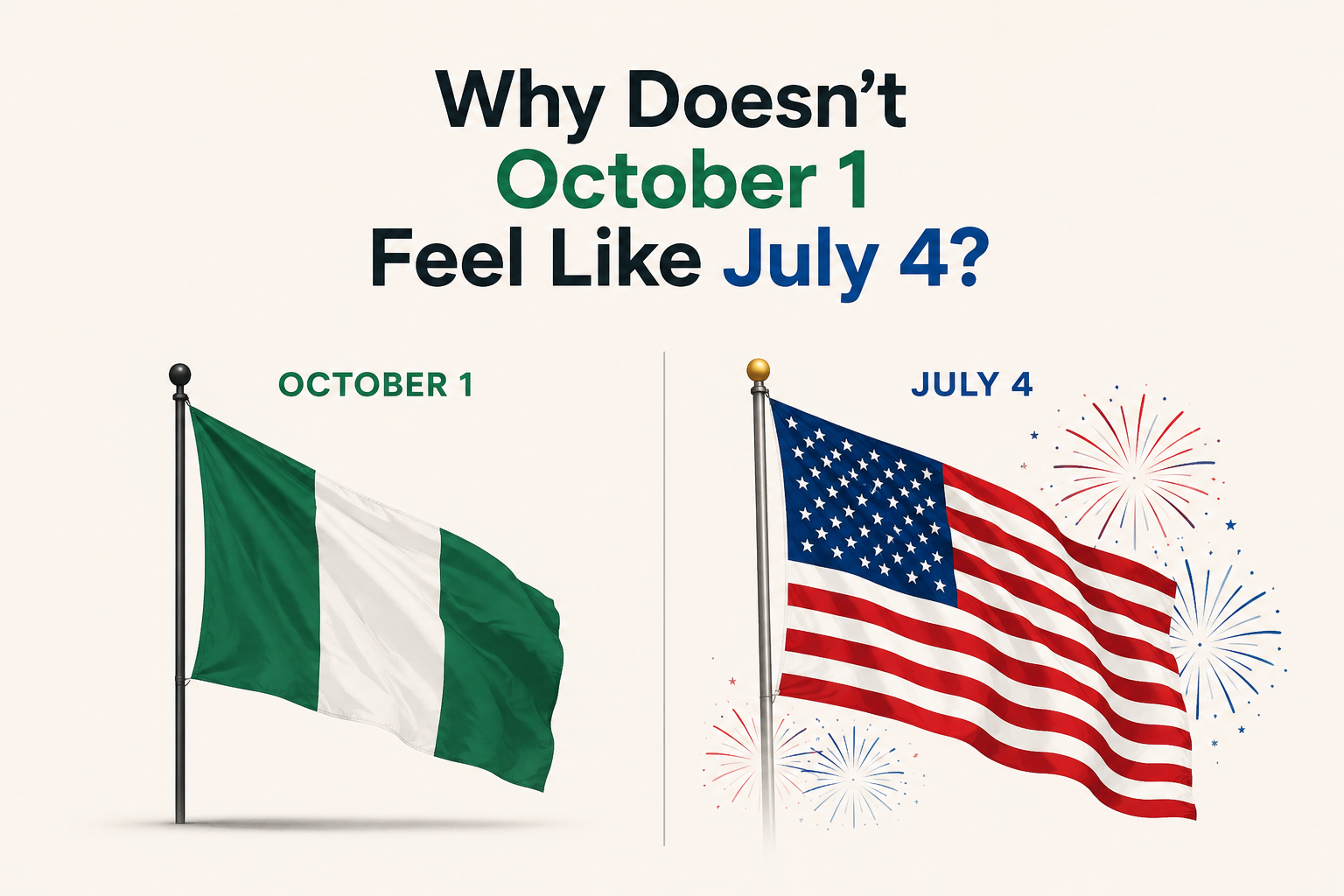
Every July 4th, American flags cover front lawns from Ohio to Osaka. Fireworks, anthems, barbecues — Americans abroad throw parties just to feel home for a night. Ask a Nigerian in Houston or London about October 1, though, and you'll often get a shrug, maybe jollof rice, rarely a flag.
That gap is worth studying honestly — not to shame anyone, but because it says something about what nationhood actually requires.
Nigerians Love Nigeria. They're Less Sure About "Nigeria"
Diaspora surveys and commentary consistently show pride in Nigerian identity — the music, the food, the humor, the hustle. Nigerians abroad wear the culture loudly. But October 1 itself lands differently depending on who you ask: some diaspora communities still throw parades, especially in New York, which hosts the largest Nigerian independence gathering outside Nigeria, and in London. Others treat it as just another Tuesday with jollof on the side.
The honest reason, according to Nigerian commentators themselves, isn't apathy — it's that patriotism and nationalism split apart early in Nigeria's story. One widely discussed analysis argues Nigerians are largely patriotic at heart but "un-nationalistic," because the state never gave people a shared project to believe in. Nigeria was assembled by colonial administrators who openly called it a collection of unrelated groups stitched together for economic convenience — not a nation forged by common cause. Add decades of corruption, and love for the culture stayed strong while faith in the state thinned out.
What July 4th Actually Teaches
America's patriotism isn't just fireworks. It's built on a founding story of shared sacrifice — a revolution fought together, a constitution argued over, and generations of civic ritual (pledges, anthems, war memorials, Memorial Day) that keep reminding people the country was earned, not inherited. Crucially, American patriotism also tolerates criticism; loving the country and criticizing its government aren't treated as contradictions.
Nigeria has its own founding heroes — Awolowo, Azikiwe, Macaulay — and a real independence struggle. But that story rarely gets retold with the same emotional weight in schools, homes, or diaspora communities. Without the story being repeated, it can't become identity.
What the Diaspora and Future Leaders Can Actually Do
- Separate love of country from approval of government. Nigerian commentators themselves argue this distinction — patriot versus nationalist — is overdue. Diaspora Nigerians can celebrate October 1 loudly while still demanding accountability; the two aren't in tension.
- Retell the founding story, especially to diaspora-born kids. Most American patriotism is transmitted at home before it's transmitted at school. Nigerian parents abroad can do the same with October 1.
- Make October 1 civic, not just cultural. Jollof and asoebi are wonderful, but pairing celebration with a small act — a remittance to a community project, a mentorship pledge, a vote in diaspora advocacy — mirrors the "sacrifice" element that gives American patriotism its weight.
- Future Nigerian governments must earn the story. No amount of parades will manufacture nationalism if governance keeps undercutting it. Trust is the actual currency of patriotism.
The Bottom Line
Nigerians don't lack pride — they lack a state that's consistently given them a reason to convert culture into nationalism. That's fixable, but it's a two-way project: government has to earn belief, and the diaspora has to keep telling the story in the meantime.
Happy Independence Day, to our Nigerian Americans.