I'm not going to lie to you, I was annoyed when we lost to DR Congo on penalties. Annoyed in that specific way where you can't even be properly angry because deep down you already knew it was coming. Another World Cup, another year of watching from the couch. Qatar all over again.
But somewhere around the third or fourth squad announcement — I think it was when Switzerland confirmed Manuel Akanji — something shifted for me. I stopped counting absences and started counting names. And the names kept coming.
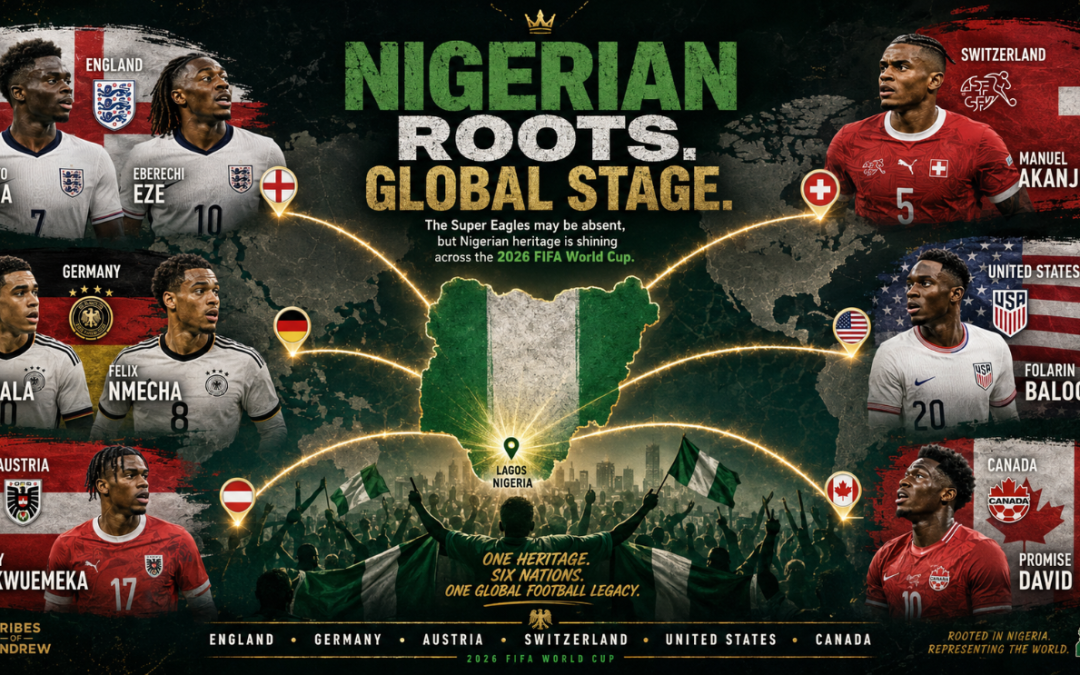
Saka. Eze. Madueke. Musiala. Olise. Nmecha. Alaba. Chukwuemeka. Akanji. Okafor. Nusa. Balogun. Oluwaseyi. David. Okon. Goodman.
Sixteen players, nine different countries, one World Cup. That's not a footnote. That's a whole tournament's worth of Naija showing up under other flags.
We didn't lose these players. We grew them somewhere else.
There's a version of this story that's all heartbreak — NFF should've scouted harder, England got there first, Germany held on tighter, blah blah blah. I get it, and some of that is fair. But sit with the other version for a second: a Yoruba father from Ogere, in Ogun State, raises a son in Vienna who becomes one of the best left-backs of his generation. That's David Alaba. An Igbo father named Kalu raises a son in Hamburg who ends up starting for Germany at a World Cup. That's Felix Nmecha. Somewhere in Stuttgart, a British-Nigerian dad and a German mum raise a kid who half the football world now calls a generational talent. That's Jamal Musiala.
None of that happens without home going with them. You don't get a tattoo of the Super Eagles crest on your arm, like Akanji has, because Nigeria is incidental to who you are. You don't post a Yoruba greeting from your trip back home — "Ẹ kú ulé o" — like Saka did, because it's just a line on a passport. That stuff travels. It survives the move, the new accent, the second national anthem.
The dads, honestly, deserve their own headline
I keep coming back to the parents in this. Noah Okafor's father, Christian, raised a son in Switzerland whose middle name, Arinzechukwu, means "God has done his work" in Igbo. Noni Madueke's dad, Ifeanyi, was out there scouting talent and clearly didn't stop scouting once he got home — his own son ended up a two-time England youth champion. These aren't footnotes either. These are men who left, or whose families left, and somehow still managed to hand their kids something unmistakably Nigerian to carry.
I think that's the part that actually gets me. Not the goals, not the transfer fees, not even the World Cup itself. It's that a father from Ogun State can raise a kid in Austria and that kid still ends up, in some real sense, Nigerian. That's not nothing. That's the whole diaspora story in miniature.
So what do we actually do with this
Maybe nothing official. Maybe we just watch. When Carney Chukwuemeka and Felix Nmecha lined up together at Dortmund, Felix said something I haven't stopped thinking about — that they're "very connected and close to where we come from," that his dad's Igbo and they "share that passion for our people." Two guys, different countries on their passports, same thing running underneath.
That's the World Cup I'm watching this summer. Not Nigeria's tournament, technically. But not not ours either.
So yeah — we didn't qualify. Again. It still stings a little if I'm honest. But turn on almost any match in this tournament and there's a decent chance someone out there grew up hearing the same names for dinner that you did. Someone whose dad sounds like your dad. Someone who, if you squint, is basically your cousin.
We're not at the World Cup. We're just everywhere in it instead.