
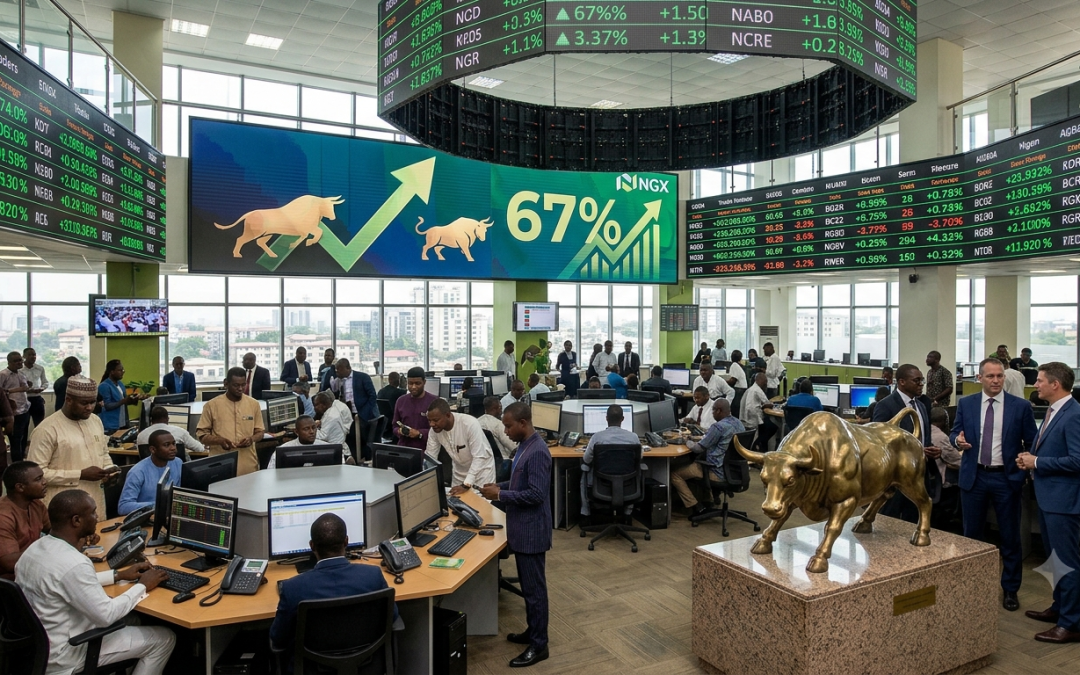
When a single financial market generates higher dollar-denominated returns than Tokyo, London, Seoul, and New York, global capital stops to pay attention. The Nigerian Exchange (NGX) in Lagos has officially outperformed every other benchmark stock index on Earth in 2026, delivering a staggering 67% yield in U.S. dollar terms. For millions of Nigerians living abroad who have watched their home currency fluctuate and foreign reserves tighten over the past decade, this unprecedented shift rewrites the narrative of African investment. The Lagos trading floor is no longer just a regional market—it is currently the world’s most lucrative equities arena.
What Happened, Where, and Who Driven It According to market tracking data published by Bloomberg across 92 global stock exchanges, Nigeria’s All-Share Index (ASI) surged past South Korea’s Kospi Index to take the top spot globally. While South Korea posted an impressive 66% return in dollar terms earlier in the year, a sharp correction in international technology and artificial intelligence equities dragged down Asian markets.
Nigeria, by contrast, surged forward. The NGX benchmark index climbed above 242,000 points, propelling total market capitalization past ₦155 trillion.
Market Metric Nigeria (NGX) South Korea (Kospi) YTD USD Return +67% +66% Global Rank (out of 92) #1 #2 Primary Market Catalyst Bank Recapitalisation & FX Liquidity AI/Tech Stock Valuation Shift Currency Impact vs USD ~+4% Naira Appreciation ~-5% Won Depreciation Several key sectors powered this historic surge:
Financial Services & Banking: Major commercial banks posted extraordinary earnings and attracted massive capital injections amid the Central Bank of Nigeria's (CBN) systemic recapitalisation mandate.
Insurance Sector: Outliers like Fortis Global Insurance Plc posted eye-watering returns exceeding 1,400% in dollar terms.
Telecommunications & Consumer Heavyweights: Telecom giant Airtel Africa experienced max-limit single-day price jumps of 10%, driving massive capitalisation gains across the exchange.
Why Nigeria Overtook Global Peers: The Core Drivers How did an exchange previously categorized as a volatile "Standalone" market leapfrog major global indices? Four fundamental economic forces collided to produce this outcome:
-
Currency Stability and Foreign Exchange Liquidity Unlike prior years where paper equity gains in Naira were erased by steep currency devaluation, 2026 has witnessed stability and marginal appreciation of the Naira (up approximately 4% against the U.S. dollar). A unified exchange rate mechanism, combined with improved foreign reserve buffers and foreign exchange clearing by the Central Bank of Nigeria, allowed international investors to repatriate dividends easily, restoring foreign portfolio investment (FPI) flows.
-
The Banking Recapitalisation Catalyst The CBN’s directive forcing commercial banks to significantly raise their capital thresholds triggered one of the largest capital-raising cycles in West African history. Through oversubscribed rights issues, public offers, and foreign direct investments, Nigerian financial institutions built fortified balance sheets capable of underwriting major infrastructure, energy, and corporate expansion projects.
-
Insulation from Global Tech & AI Volatility South Korea’s Kospi index suffered heavily from foreign capital outflows as international funds rebalanced away from high-priced chipmakers and AI hardware stocks. Because listed companies on the Nigerian Exchange have direct exposure to real-economy sectors—banking, cement, telecommunications, agriculture, and oil & gas—Lagos was completely insulated from the global tech sell-off.
-
International Institutional Endorsement S&P Dow Jones Indices formally announced Nigeria’s placement on its 2027 Frontier Market Watchlist for potential reclassification from "Standalone" status. Temi Popoola, Group Managing Director and CEO of NGX Group, noted that this inclusion reflects structural upgrades in market regulation, settlement cycles (transitioning to T+1), price discovery, and operational transparency.
WHY THIS MATTERS TO THE NIGERIAN DIASPORA For decades, members of the Nigerian diaspora across the United States, Canada, the United Kingdom, Europe, the Middle East, and Asia have relied almost exclusively on real estate or family remittances to invest back home. The rise of the NGX into the world's top-performing stock market radically changes the wealth creation playbook for Nigerians abroad.
-
High-Yield Diversification Beyond Real Estate Diaspora investors frequently face landlord disputes, construction cost inflation, or property management fraud when building real estate back home. The equity market offers a liquid, regulated alternative backed by audited corporate balance sheets, dividend payouts, and immediate exit capability.
-
Protecting Dollar Value Against Inflation Because the benchmark returns (+67%) are calculated in U.S. dollars, diaspora investors who converted foreign currency into Naira equities at the start of the year netted higher real returns than if they had left funds in S&P 500 index funds, High-Yield Savings Accounts (HYSAs), or European bonds.
-
Direct Wealth Creation via Digital Trading Apps The democratization of Nigerian capital markets through mobile fintech portals (such as Trove, Bamboo, Chaka, and official broker platforms) means a Nigerian working in London, Toronto, or Houston can purchase shares on the NGX within minutes using foreign cards or diaspora bank accounts.
-
Shifting Global Perception of Nigerian Assets A market ranked #1 globally shifts the institutional narrative from "emerging risk" to "essential frontier allocation". International hedge funds, sovereign wealth funds, and private equity firms are expanding their Lagos desks, lifting valuations across all local asset classes.
Comprehensive Impact Analysis For Nigeria’s Domestic Economy: Higher stock market valuations reduce the cost of capital for domestic firms, enabling them to expand operations, employ more citizens, and increase tax revenue for public infrastructure development.
For the Diaspora: Presents a viable hedge against western economic slowdowns while offering capital accumulation that outpaces Western inflation rates.
For Africa: Re-establishes West Africa as a vibrant financial hub, challenging Johannesburg’s long-standing dominance as the sole gateway for institutional African equity investments.
For Foreign Institutional Investors: Signals that macroeconomic policy reforms—such as fuel subsidy removal, FX unification, and monetary tightening—are yielding tangible balance-sheet results.
Key Takeaways World Number One: The Nigerian Exchange (NGX) surpassed South Korea’s Kospi Index to become the best-performing stock market globally in 2026, posting a 67% USD return.
Currency Support: A stabilized Naira, which appreciated ~4% against the USD YTD, amplified dollar returns for overseas investors.
Banking Sector Surge: Systematic banking recapitalisation mandates by the CBN drove intense investor interest and capital inflow into financial stocks.
Global Tech Shield: Limited market exposure to overvalued AI and semiconductor stocks protected Lagos from the global tech sector corrections that dragged down Asian indices.
Institutional Upgrade Watch: S&P Dow Jones Indices placed Nigeria on its 2027 Frontier Market Watchlist, paving the way for billions in passive global index funds.
Massive Capitalisation: The NGX All-Share Index crossed historic highs of over 242,000 points, taking total equity market capitalisation past ₦155 trillion.
What Happens Next? As the initial euphoria settles, institutional analysts and regulators are focused on sustaining this momentum. Here is what investors should expect over the next 6 to 18 months:
Inflow from Index Tracking Funds: If S&P Dow Jones formally upgrades Nigeria from "Standalone" to "Frontier Market" in 2027, automated global frontier funds will be required to buy Nigerian equities, driving another wave of capital liquidity.
Completion of Banking Recapitalisation: Banks that successfully meet CBN deadlines will emerge with immense lending capacity, boosting corporate earnings across construction, agriculture, and manufacturing.
Risks to Watch: Sustaining this bull run requires the Central Bank to maintain foreign exchange market liquidity, control domestic inflation, and ensure policy consistency. Any sharp drop in crude oil prices or geopolitical shock could re-introduce volatility.
Join the Discussion: What Is Your Take? Have you considered allocating part of your investment portfolio to the Nigerian stock market, or do you still prefer physical real estate?
For diaspora professionals in finance and tech: What additional tools or platforms would make investing in Nigerian equities easier from abroad?
How can the Nigerian government ensure that this financial market rally translates into tangible job creation and living standards back home?