Nigeria’s relationship with Washington has entered uncomfortable territory.
On July 15, 2026, the United States House of Representatives passed H.R. 8595, the National Security, Department of State, and Related Programs Appropriations Act for the 2027 financial year. The legislation passed narrowly by 217 votes to 209.
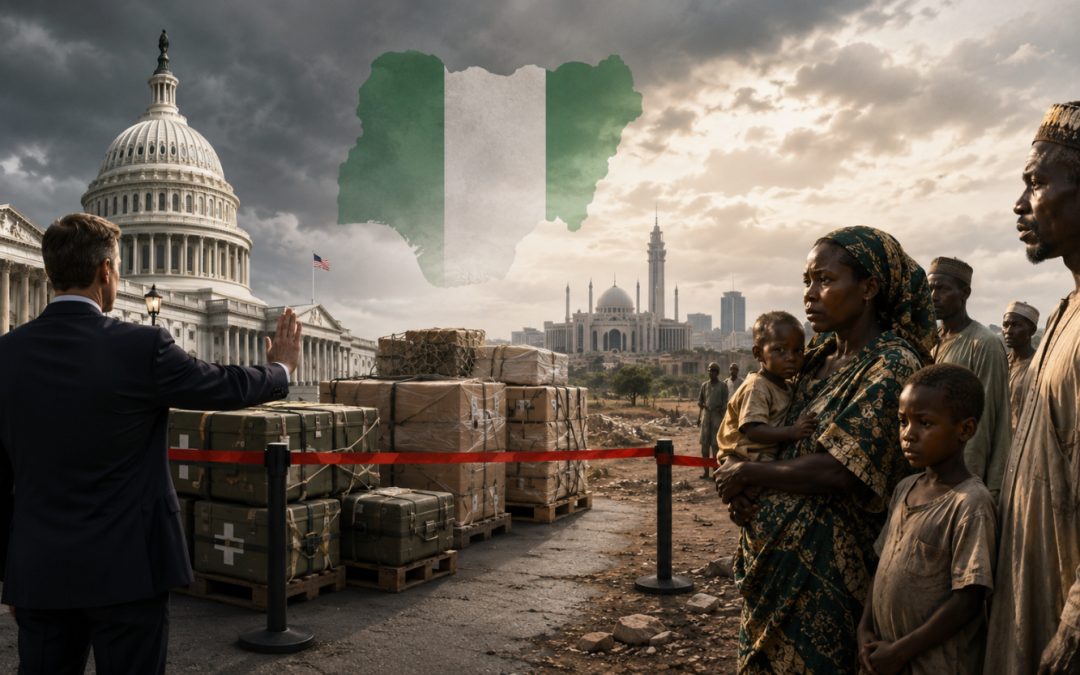
One of its most consequential provisions for Nigeria would prevent the release of covered U.S. economic and security assistance until the American secretary of state certifies that the Nigerian government is making measurable progress in protecting Christian communities and combating religious violence. An earlier version proposed withholding 50 percent. A successful amendment increased that figure to 100 percent.
That is serious. But it is not the same as saying, “The U.S. Congress has frozen all aid to Nigeria.”
What has actually happened?
Only the House has approved the measure so far. The Senate must consider its own version of the spending legislation. Differences between the two chambers would then have to be reconciled before a final bill could be sent to the president.
Until that process is completed, the House vote does not itself shut down ongoing programmes in Nigeria.
The restriction is also better understood as a conditional hold on economic and security assistance than as a guaranteed cancellation of every American dollar connected to Nigeria. The final legal language, exemptions, certification process and any presidential waiver would determine exactly which programmes are affected.
Humanitarian activities delivered through international organisations, charities or nongovernmental groups may also be treated differently from money or equipment provided directly to the Nigerian government.
The accurate headline is therefore:
The U.S. House has voted to make qualifying aid to Nigeria conditional on action against religious violence. The proposal could produce a complete freeze, but it is not yet law.
Did American lawmakers officially declare Tinubu’s government corrupt?
Not exactly.
Representative Greg Steube of Florida, who sponsored the amendment expanding the restriction from 50 percent to 100 percent, argued that American taxpayers’ money should not be directed to “corrupt regimes” that fail to protect religious freedom, confront terrorism or protect innocent people.
That was forceful political rhetoric used to support his amendment. It was not a formal judicial finding that President Bola Tinubu personally committed corruption, nor was it an official congressional declaration that every part of the Nigerian government is corrupt.
Steube said the purpose was not to punish ordinary Nigerians but to demand accountability from a government he accused of complacency. He argued that if conditions were serious enough to block half the assistance, they were serious enough to block all of it.
The distinction matters. Social-media headlines have combined the lawmaker’s “corrupt regimes” language with the House vote and presented the result as though the entire U.S. government had formally branded Tinubu corrupt and immediately cancelled every form of aid.
That is an exaggeration.
How did Nigeria get here?
The immediate dispute centres on worsening insecurity and allegations that Nigerian authorities have failed to protect Christian communities from targeted violence.
For years, members of the U.S. Congress, religious-freedom organisations and Nigerian diaspora advocacy groups have highlighted attacks on churches, Christian villages, priests, farmers and internally displaced communities. They argue that arrests are rare, prosecutions are weak and successive Nigerian governments have treated recurring massacres as isolated clashes rather than a national emergency.
The Nigerian government rejects the description of the crisis as a simple campaign of Christian persecution. Abuja maintains that Boko Haram, Islamic State affiliates, bandits, kidnappers and armed groups kill both Christians and Muslims. It argues that many attacks are driven by overlapping factors: terrorism, criminality, land disputes, ethnic tensions, weak policing, competition over natural resources and the collapse of local authority.
Both arguments contain important truths.
Christians have unquestionably suffered devastating attacks, especially in parts of the Middle Belt and northern Nigeria. Muslim communities have also been massacred, displaced and terrorised. Nigeria’s security crisis cannot honestly be reduced to one religious explanation. But the complexity of the violence does not excuse the government’s repeated failure to prevent attacks, rescue abductees, prosecute perpetrators and provide credible public information.
Washington’s pressure intensified after the Trump administration redesignated Nigeria as a “Country of Particular Concern” over religious-freedom violations in October 2025. Congressional attention subsequently grew, with lawmakers demanding stronger conditions on assistance.
The House Appropriations Committee initially approved language withholding part of Nigeria’s assistance until measurable steps were taken to protect Christian communities. The House later adopted the tougher amendment requiring all covered assistance to be withheld pending certification.
A confusing message from Washington
The vote came at a time when parts of the Trump administration appeared to be improving relations with Abuja.
Frank Garcia, the U.S. assistant secretary of state for African affairs, had recently made Nigeria the first stop of his initial official African trip. American and Nigerian officials had also been discussing counterterrorism and security cooperation.
This reveals an important division in Washington.
The executive branch sees Nigeria as a strategic partner: Africa’s most populous country, a major oil and gas producer, an important regional power and a necessary partner against jihadist organisations.
Some Republican lawmakers, however, believe quiet diplomacy has failed. They want American aid used as leverage to compel visible security and religious-freedom reforms.
What could the freeze mean for Nigerians?
Health programmes could come under greater pressure
American support has historically helped Nigeria fight HIV, malaria, tuberculosis and other infectious diseases, while strengthening laboratories, health-worker training, surveillance and medicine distribution.
Nigeria already experienced disruption after broad U.S. foreign-assistance cuts beginning in 2025. The National Assembly approved roughly $200 million in additional health funding that year to compensate for part of the expected shortfall. The earlier reductions demonstrated that aid freezes do not mainly inconvenience politicians. They can interrupt treatment, prevention work and community health services.
The precise health impact of H.R. 8595 would depend on which programmes are legally covered and whether humanitarian or global-health exceptions survive the Senate negotiations.
Counterterrorism cooperation may suffer
Nigeria benefits from American intelligence, training, equipment, surveillance capacity and cooperation against Boko Haram and Islamic State-linked groups.
Conditioning security assistance may force Abuja to improve accountability and civilian protection. But a prolonged cutoff could also weaken the same institutions expected to defeat the armed groups attacking vulnerable communities.
That is the central contradiction: Washington wants Nigeria to stop terrorism, but removing security assistance could make that task harder unless the restrictions are carefully targeted.
Hunger and displacement could worsen
Northern Nigeria is already facing a severe humanitarian emergency. In July 2026, the World Food Programme reported that more than 17 million people across nine conflict-affected northern states were experiencing crisis-level hunger or worse. More than three million people were acutely food insecure in Borno State alone.
Earlier funding shortages had already forced the WFP to reduce nutrition support, affecting more than 300,000 children. At one point, the agency expected to reach only 72,000 people in a month, compared with 1.3 million during the previous lean season.
Although multilateral humanitarian programmes may not all be directly covered by the House restriction, a broader American retreat would further strain a system that is already running short of money.
Nigeria’s international reputation may take a hit
Even before the measure becomes law, the House vote sends a damaging political signal.
Investors and diplomatic partners may interpret it as evidence that Washington lacks confidence in Nigeria’s ability to protect citizens, manage security assistance and account for foreign support. That does not automatically cause capital flight, but it adds another layer of reputational risk to a country already dealing with insecurity, inflation, weak public institutions and concerns about corruption.
Ordinary families and the diaspora may carry more of the burden
When medical, food or displacement programmes lose funding, Nigerian families often turn to relatives abroad.
Diaspora Nigerians may face increasing requests for hospital bills, food, school fees, relocation costs and emergency support. Remittances become an informal welfare system filling gaps left by both the Nigerian state and international donors.
This is why the diaspora should not view the dispute as a distant argument between Washington and Abuja. The consequences may eventually appear in family WhatsApp groups, fundraising appeals and rising demands for support.
Could the pressure produce positive change?
Possibly.
Foreign assistance should not become permanent financing for a government that refuses to address impunity. Conditions can push governments to investigate massacres, prosecute offenders, improve military conduct, publish security data and protect threatened communities.
However, broad aid freezes are blunt instruments. Political elites often survive them, while clinic patients, displaced families and rural communities suffer first.
A more effective approach would combine targeted sanctions against culpable officials, strict auditing of security assistance, direct funding for trusted humanitarian organisations and specific benchmarks for restoring aid.
Those benchmarks could include credible prosecutions, improved early-warning systems, faster military responses, protection for high-risk communities and transparent reporting of attacks and casualties.
What happens next?
The Senate is now the key institution to watch.
It may accept the House restriction, soften it, add humanitarian exemptions or remove it entirely. Any differences would have to be negotiated before final passage. President Trump would then decide whether to sign the full appropriations bill.
The Tinubu administration will also intensify diplomatic engagement in Washington. But lobbying alone will not settle the issue. Nigeria will need to demonstrate concrete security improvements rather than merely argue that foreign critics misunderstand the country.
The central fact remains uncomfortable: the United States is no longer treating Nigeria’s insecurity only as an unfortunate domestic problem. A significant section of Washington now views it as evidence of government failure serious enough to justify withholding assistance.
The House has fired a warning shot. Whether it becomes binding American policy—and whether Abuja responds with reform or public relations—will determine what comes next.